Afloat in South Asia

Afloat in South Asia
Reclining Buddha; Rangoon

Friday, February 11, 2011

Penang - Sat. Jan.23rd

Malacca has a few tall buildings, but has a very sleepy feel to it. Penang, on the other hand, is bustling. As we approached it from the sea, we felt as though we were coming along the south side of Hong Kong island. Tall residential towers clustered gracefully along the curving shore. Unlike on the approach to Hong Kong, though, we enjoyed clear skies and several kinds of dolphins frisking with the boat.

The observation about the prior wealth of this region holds true in spades in Penang. Along with the art deco shophouses, there are dozens of beautiful, crumbling western-style mansions from the early years of the last century. Although Penang is becoming very built up (with Singaporean money investing heavily), the homes of “Millionaires Row” along the praya are supposedly protected. As you can see from this photo, though, it looks as though the doctrine of “constructive demolition” is a problem here, as it is in many historic districts.
I was sorry to miss getting a photo of a beautiful yellow stucco mansion with dozens of windows and a lovely garden. It bore the date “1924” over its front door and it looked as if it were just holding on, braced as it was by two highrise apartment towers.

No longer a rubber baron’s paradise, Penang today has a very large high tech assembly and semiconductor fab industry. Even so, there are still villas with stained glass dating back to the 1880’s and the Sarkies’ hotel, the Eastern & Oriental, looks every bit as restored as its Singapore cousin, Raffles. Here is a stucco confection from the 1920's


We had a fine tour of the “Blue Mansion”, former home of Cheong Fatt Tze. It is a remarkable house – with multiple courtyards and many staircases. Surprisingly, part of “Indochine” was filmed there and they are still proud of having hosted Catherine Deneuve! Now a 16-room boutique hotel, it was built by a Hakka millionaire who loaned Sun Yat Sen and Charlie Soong $3 million in 1914 to finance the “new” China (no..he did not get the money back).


While we waited to go into the house for our tour, Bryan spotted this rare beast, which he assured me is a “Straits Coon Cat”… >

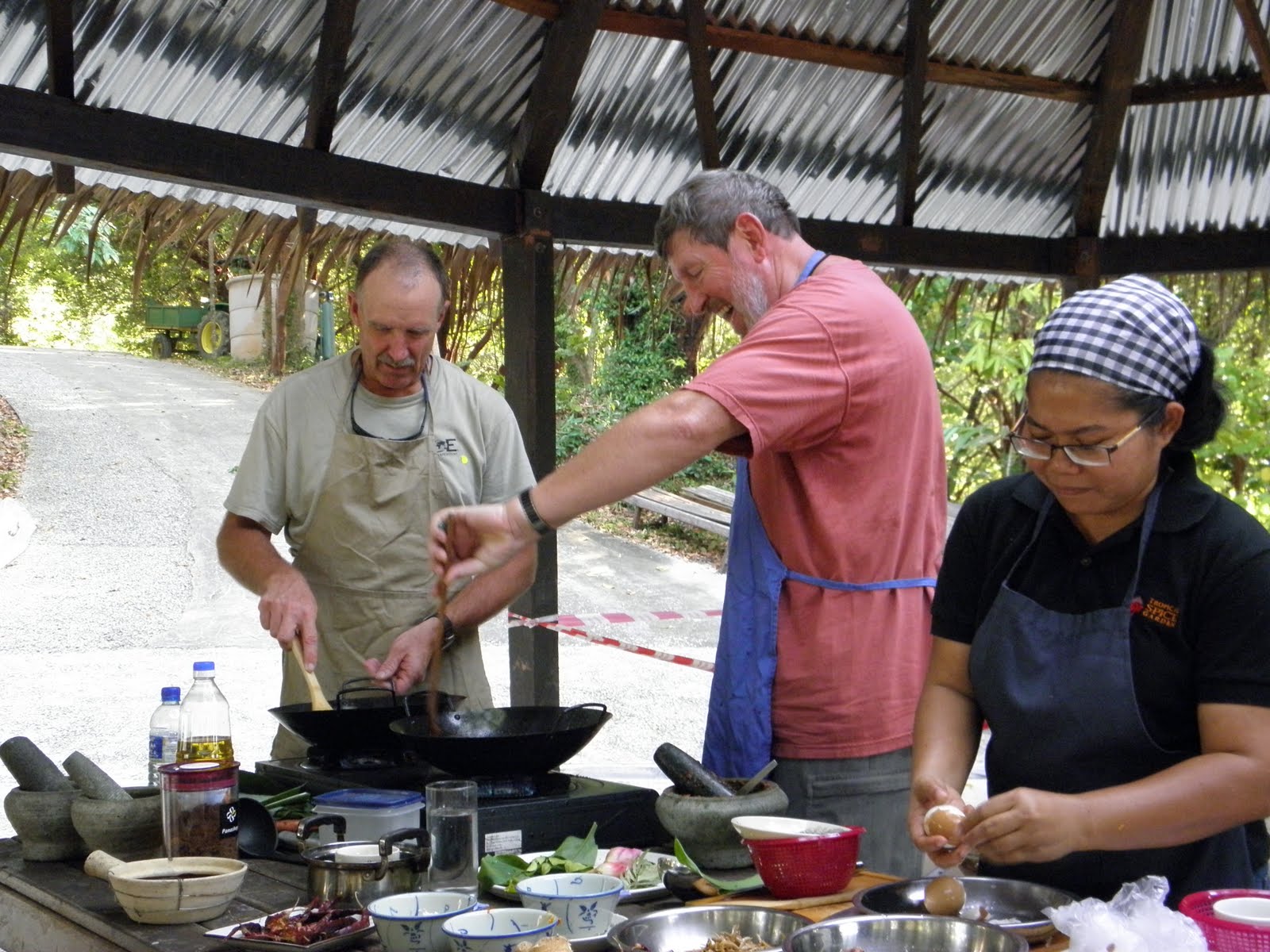
In the afternoon, Bryan and I went on an excursion to a spice farm. At the end of a fascinating walk through a spice forest, we had the chance to cook local food under a tarp set up in the open air. To my surprise, Bryan stepped right up when the instructor asked for volunteers. He was joined by Kevin Clement, one of the naturalists travelling with our group. Wow! What a dynamic duo! Here they are, hard at work, Bryan on his sambal and Kevin on his curry.
Malacca - Fri., Jan.21st

Ah, Malacca. We have wanted to explore the Straits settlements for years. These communities, set up by traders hundreds of years ago - first the Portuguese, then the Dutch and finally the Brits - evoke the romance and danger of the spice trade on the high seas. This particular port has grown pretty sleepy. As you can see, tourists are a major source of revenue, though frankly there are not even that many tourists.


Like many other “traditions” in this part of the world, the flowers on the trishaws are of recent vintage…they date to some event in the 1990’s!


We hauled ourselves up the hill, past the remains of the Portuguese fort. From the hulk of the Dutch church, we saw a magnificent white-bellied sea eagle land on the adjacent radio tower.


We took a tour of a terrific Baba Malay (see Peranakans above) house. It was tucked into a lane in a very Chinese-looking neighborhood. Behind the ordinary façade there was a complex that included seven courtyards and carved woodwork that looked so Chinese in its carving and gilding – yet the wood was teak and therefore had a softer look to it. Here is the exterior. Unfortunately, like many private museums, this one did not allow interior photography.


One thing that struck me here reinforced something I’d noticed in Singapore – many of the charming older shophouses date back only to the 1920’s and 1930’s. The years before the Depression took hold were grand days in these parts. Great fortunes were made and then lost. Just to give an idea of the scale of the decline, the price of rubber was $1.20 per pound in 1910. By 1935 it was $0.20 per pound. It seems Malacca has been been waiting quietly for about 75 years to see what the next great thing will be.....

The Singapore Botanical Garden - Thurs. Jan. 20st

We joined our group for its first official outing, which was a visit to the Botanical Garden.
It was a thrill to me to be able to photograph the Nepenthes in the Botanical Garden at Singapore, much as Marianne North painted them in 1876. North was a botanical artist and an adventuress who travelled from England to these parts. She left us a remarkable gallery at Kew crammed with over 800 of her botanical paintings done in all the fascinating nooks of the world. I have her autobiography with me (on an iPad, of course) and she will appear from time to time over the next few weeks. Our guide mentioned that the Maharajah of Johore still owns the land adjacent to the Botanical Garden. Marianne North had dinner with the Maharajah’s ancestor and remarked on his beautiful velvet coat with diamond buttons, as well as his turban, his perfect English, excellent manners – and his skill at billiards!

Here is Marianne North, as photographed by Julia Margaret Cameron in Ceylon in 1876.Marianne North01

And here is one of her paintings of her precious Nepenthes. She wrote that "The Botanical Garden at Singapore was beautiful. Behind it was a jungle of real untouched forest...in the jungle I found real pitcher-plants ...It was the first time I had seen them growing wild and I screamed with delight." Nepenthes northiana by Marianne North
And here is my photograph of the Nepenthes in the Garden today....


We headed back out into the streets of modern Singapore, where traffic was a bit snarly. It is the Hindu festival of Thaipusam, which is celebrated in heavily Tamil areas and in the Straits settlements. During the kavadi, or burden-bearing, portion of the festival, those who want to atone for their sins strap on a devilish metal cage the holds sharp metal spears that pierce the flesh. The devotee then walks for miles being tortured by this device before being freed from it and soothed by his family and friends. Probably just as well my photos of this gruesome procession, taken from the moving bus, did not turn out well…Suffice to say, we are not in Kansas any more….

This evening we went aboard our ship, the Clipper Odyssey. With 95 passengers, 77 crew and 17 tour staff, we should be well looked-after!

Last full day in Singapore – Wed. Jan.19th


We spent the morning at the Peranakan Museum, the museum of the Straits Chinese and Indians. Emblematic of the progress in Singapore in the past ten years, this museum used to be housed in a little Peranakan bungalow; now it is in a lovely 1907 building that used to be a Hokkien School. The whole thing is on a much grander scale, though it does still focus mainly on the origins and traditions of the Straits Chinese. The Peranakans are descended from Chinese or Indian traders who intermarried with local women. Though many of their traditions hark back to their Chinese or Indian origins, they are set apart by their language, Baba Malay or Chitty Malay.

At lunch we went off to the hawker bazaar with our Hong Kong friend, Rob Christie. This particular market is housed in a wonderful old iron building that was actually moved a block or so to accommodate Singapore’s newest subway line. This seems typical of Singapore, which has been fortunate enough to modernize a decade or so later than Hong Kong. Unlike the ethos during the great building boom in HK, the Singaporean aesthetic seems to lean a bit more towards preserving interesting buildings. Here's a picture of the beautiful hawker bazaar...


Bryan was in total heaven in this temple of Asian food. He was spoiled for choice. Here is one that he passed up, though…


I scored big by finding the best dim sum – a yummy lunch was had by all. Here are Rob Christie and Bryan as we left lunch.


In the evening we met our travel group over dinner at the hotel. We had the advantage in that we were not jetlagged, so we were able to slip away afterwards for drinks with Rob and Animal (Dave Slater), who was in from Hong Kong on business. It has been SO fun to see so many of our dear Hong Kong buddies here!

Tuesday, January 18, 2011

Out and about with Sukhdeep


After a full eight hours of sleep we were raring to go. Bryan's dear friend from our HK days, Sukhdeep Singh, collected us at the hotel and we headed out to see the town.

The first stop was the Singapore Flyer, a cousin of the London Eye. The Flyer gives a great overview of the city. Each car can hold 28 people, though we were lucky enough to have one to ourselves so we could range freely and admire the view.


Here is the bay area around our hotel. Like so many places in Asia, Singapore has grown tremendously in every way over the past 15 years.

The wildest addition to the skyline is the new casino that looks like a boat borne aloft. Here is a view from the Flyer, which brought us to eye level with the amazing boat-like deck.....
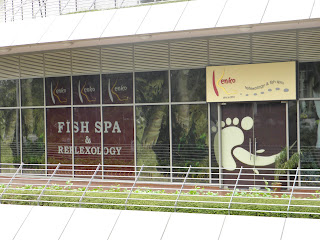



On the way back to the car, we stopped to check out the latest in personal services in Singapore. At the fish spa, your pedicure is fine-tuned by letting little fish nibble the bits of dead skin from your feet. The kicker is that you get to choose how close a nibble you want; there are three tanks to choose from and the fish range from small to medium to large!


Next stop was the war museum at Changi. This was bound to be harrowing. I can remember being told as a child that Changi was among the worst POW camps of WII. We strapped on our audio guides and began to make our way around. Sukhdeep disappeared after a minute or so. It turned out that the director of the museum, who introduced the audio tour, is an old army friend of Sukhdeep's. S. went to the office found Jeya Ayadurai and we all went to lunch in Changi town. It was really fun to listen to those two debate the future of their country and interesting to hear Jeya's saga of getting the authorities to let him create the Changi Museum. Sukhdeep is on the right and Jeya is in the middle of this picture.


We had about an hour left of our tour so Sukhdeep took us to the other extreme of Singapore. The famous black and white houses on Mount Pleasant Road were build as posh colonial accommodation in the 1920's and '30's. I have seen them now and then in shelter magazines, sporting the latest facelift. To see a dozen or more of these gracious AngloAsian homes arrayed along leafy Mount Pleasant Road was a treat.

The grandest black and white of them all is the Senior Police Officer's Club. Here is Bryan entering this calm, airy building...


We headed back into the city and saw this truck as we stopped for a light. As always, Asia touches the sense of whimsy. The catering truck assures us that "Party Planning has never been easier". I'll have to get them to FEDX some of those fish heads for our next dinner party.


Walking back to the hotel we saw a cool public sculpture. This piece is about 30 feet high and consists of some 3000 Starbucks cups, plus plastic bottles. The artist periodically has workshops where the public can come and add to the piece.


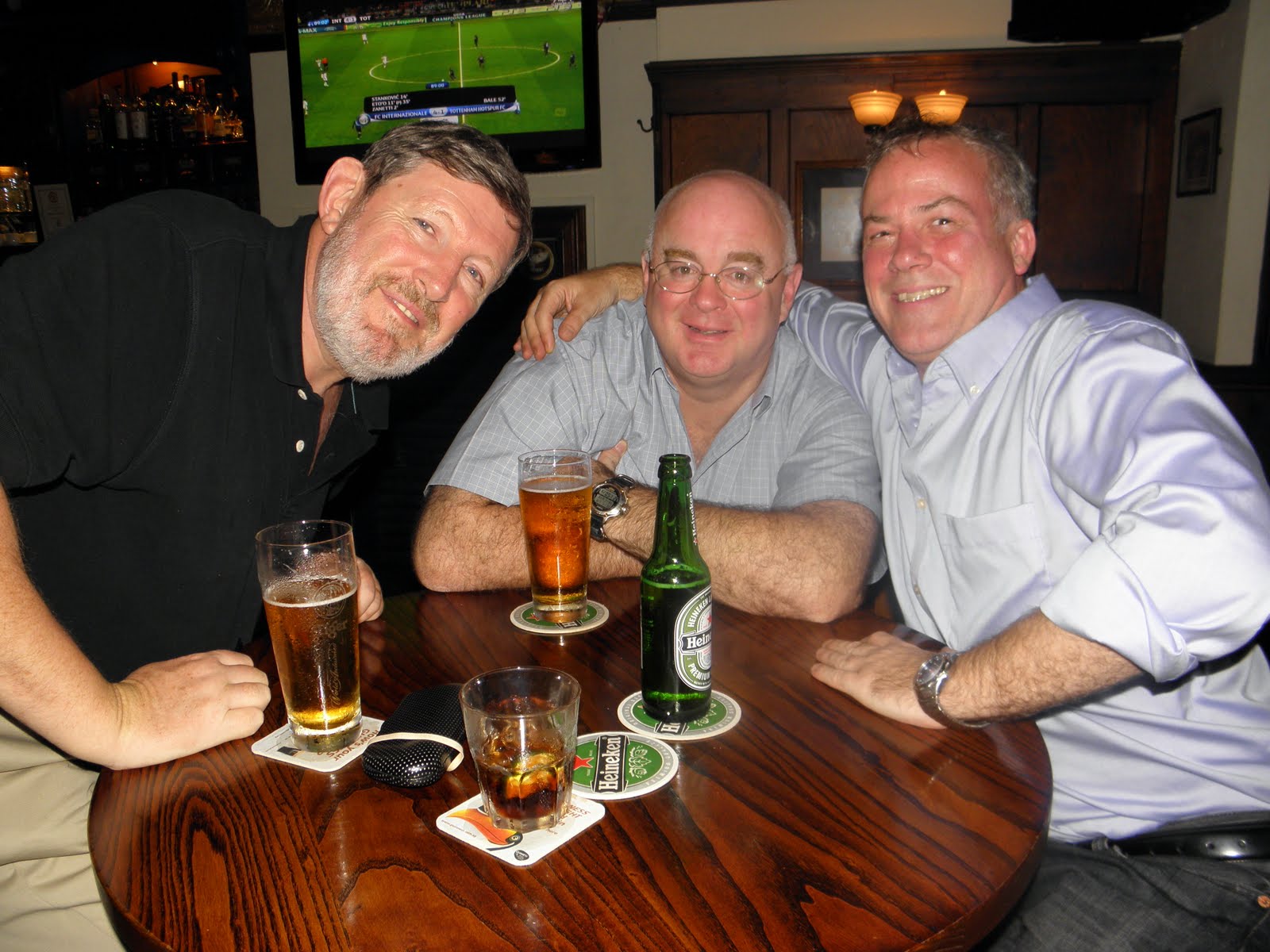
In the evening we set out across the bridge to the Singapore Cricket Club. There we met Tony Egerton and a couple of the other folk from Bryan's Centre Re office in Hong Kong. Starting in the main bar and moving to the curry feast on the verandah, it was a long, fun evening. Here is Tony.....


And here is Singapore by night, from the verandah of the Cricket Club....

And so, again, so bed. We just do not have time for jetlag!

Monday, January 17, 2011

Birds in the Lion City

The longest commercial air route in the world is 18 hours from Newark to Singapore, direct. SQ accomplishes this by filling an A340-500 with only 105 business-class passengers and what a service it is! We arrived over an hour early, which put us at the Fullerton Hotel by 7am. This beautiful hotel was carefully inserted into the bones of the 1928 building that housed Singapore's general post office, stock exchange, ministry of finance and The Singapore Club. During a nice (very) early morning stroll, we planned the day ahead.


As I look back at this day, it epitomized what I look for in my travels - history, critters and friends - not necessarily in that order. On this sunny morning, we set forth on the MRT (Singapore's subway system) to get to Boon Lay, the stop nearest the Jurong Bird Park. I had fond memories of this park from ten years ago. It had the first large scale netted aviaries I had ever seen. The concept that a bird could be born, live, mate and die within the confines of a forest under a huge net was mind-blowing. At the same time, the place was distressing because the birds outside the nets lived in small, sad enclosures. The raptors were especially bleak. So - we set forth the see how the place was doing. Here are some of the critters who made it a wonderful afternoon....

The Loris are real Australian characters. We got the requisite little tub of Lori food and had a fine time with them.


This one was all over me! In this photo he was rifling my purse! I was not hiding any food in there - promise! I was not able to catch it on film, but this same fellow liked to lick my arm...salt deprived?


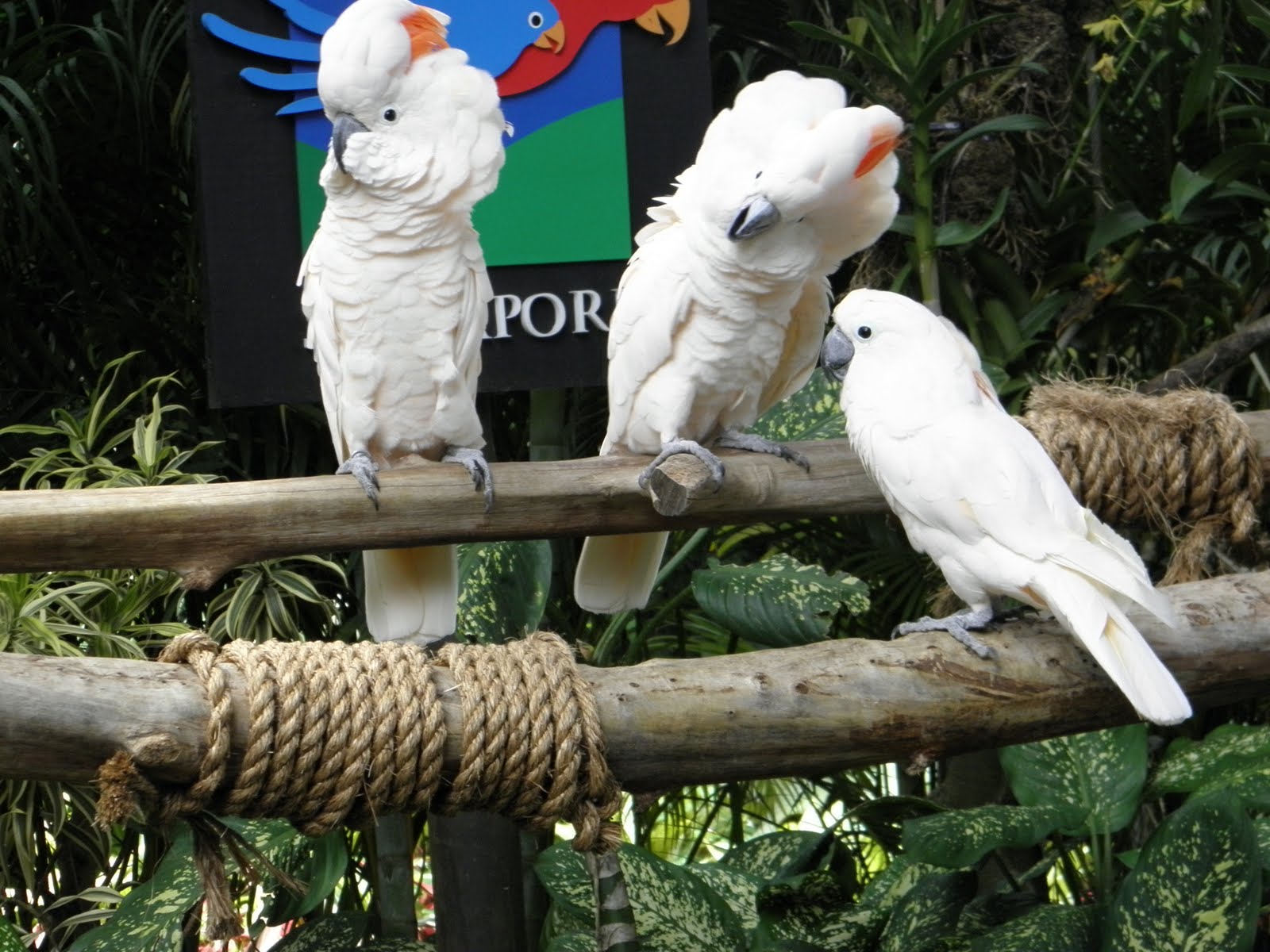
Everyone who knows me knows I love cockatoos. This pair was very demure....


These guys were more raucous and playful


And who could resist these parrots??


Another soft spot in my head is reserved for flamingoes. This guy and his friends get plenty of shrimp. There is another pool of flamingoes with a much paler pink color.
In amongst the pale flamingoes are some cool-looking spoonbills. This guy is taking off...

Sun conures are nearly extinct in their native South America - only about 1500 left in Brazil.
Jurong has a couple of hundred flying around in this aviary, where they were bred.


Finally - one last sultry, Australian gaze.......


We ended our first day with a visit with an old friend from painting class in Hong Kong. Caroline Mars lives with her family in Singapore now. She has expanded her skills beyond her Chinese painting...we last met when she was exhibiting in a gallery in NY's Chelsea. We saw Caroline and Rob in their sleek flat in the green belt - here we are standing in front of her installation based on the tenets of fung shui.


The tales of how this piece was made are fun! Getting her son to help set fire to the canvas with a hole; having the family help throw paint at a canvas from 4 flights up onto the top middle canvas....
After a fine Vietnamese dinner near our hotel with Caroline and Rob, we finally found our bed.


Saturday, January 15, 2011

The posts from South America will have to wait - we are off to Asia tonight.

The photo above notwithstanding, this is the beginning of a series that will take us from Singapore to Chennai, by boat. All the wonderful pix and stories from last autumn's South America trip will appear when we get back from Asia.


Next stop: Singapore!!